Basic Crochet Stitches for Beginners: The 6 You Need
The 6 basic crochet stitches every beginner needs: chain, slip stitch, single, half double, double and treble crochet, with steps, heights and uses.
By Ayoub Farid · · 4 min read
Almost every crochet pattern, from a dishcloth to a lace shawl, is built from six basic stitches. Fancy stitches like shells, puffs and clusters are just these six, grouped or stacked in different ways.
Learn them in the order below. Each one adds a single extra step to the one before, so they build on each other naturally. All names are in US terms (see US vs UK crochet terms if you learned the UK way).
At a glance
| Stitch | Abbrev. | Height | Turning chain | Fabric |
|---|---|---|---|---|
| Chain | ch | — | — | Foundation |
| Slip stitch | sl st | Almost none | — | Joining, moving |
| Single crochet | sc | 1 | Ch 1 | Dense, firm |
| Half double crochet | hdc | 2 | Ch 2 | Soft, quick |
| Double crochet | dc | 3 | Ch 3 | Open, drapey |
| Treble crochet | tr | 4 | Ch 4 | Lacy, airy |
"Height" is roughly how many chains tall the stitch stands, which is why the turning chain grows with each stitch.
1. Chain (ch)
The starting point. From a slip knot on your hook: yarn over, pull through the loop on the hook. Repeat.
Used for: the foundation of most projects, turning chains, and the spaces in lace and granny stitches.
2. Slip stitch (sl st)
The shortest stitch. Insert the hook, yarn over, pull through the stitch and the loop on the hook in one motion.
Used for: joining rounds, moving to a new position without adding height, seaming, surface decoration.
3. Single crochet (sc)
The workhorse of crochet and the stitch of nearly all amigurumi.
- Insert the hook into the stitch.
- Yarn over, pull up a loop (2 loops on hook).
- Yarn over, pull through both loops.
Used for: amigurumi, dishcloths, bags, sturdy scarves, edgings. Full tutorial: how to single crochet.
4. Half double crochet (hdc)
Taller than sc, faster to work, with a soft and slightly stretchy fabric.
- Yarn over first.
- Insert the hook, yarn over, pull up a loop (3 loops on hook).
- Yarn over, pull through all 3 loops.
Look closely and you'll see a third horizontal loop just below the top of each hdc. Some patterns use it ("work in the third loop") for a knit-like rib.
Used for: hats, blankets, scarves, anything you want to make quickly.
5. Double crochet (dc)
Twice the height of sc, with visible gaps between the posts. The basis of granny squares and most lace.
- Yarn over.
- Insert the hook, yarn over, pull up a loop (3 loops).
- Yarn over, pull through 2 loops (2 loops left).
- Yarn over, pull through the last 2 loops.
Used for: granny squares, shell stitch, blankets, shawls. Full tutorial: how to double crochet.
6. Treble crochet (tr)
The tallest of the basic stitches.
- Yarn over twice.
- Insert the hook, yarn over, pull up a loop (4 loops).
- Yarn over, pull through 2 loops; repeat from 2 more times.
Each additional yarn over at the start makes an even taller stitch: double treble (3 yarn overs), triple treble (4) and so on.
Used for: lace, open shawls, tall clusters, flower petals.
How the basic stitches combine
Once you know these six, "new" stitches are mostly recipes:
- Shell: 5 dc in one stitch
- V-stitch: (dc, ch 1, dc) in one stitch
- Granny cluster: 3 dc in one space
- Moss (linen) stitch: sc, ch 1, skip 1, repeat
- Puff: several half-finished hdc, then yarn over and pull through all loops
- Ribbing: front and back post dc
Want to recognize these stitches in finished pieces? See our crochet stitch identifier guide.
Practice plan
- Day 1: chain 20, then 10 rows of sc. Count every row.
- Day 2: the same swatch in hdc.
- Day 3: the same in dc. Notice the turning chain counts as a stitch now.
- Day 4: make your first project: a scarf or a coaster.
Learn the stitches in real patterns
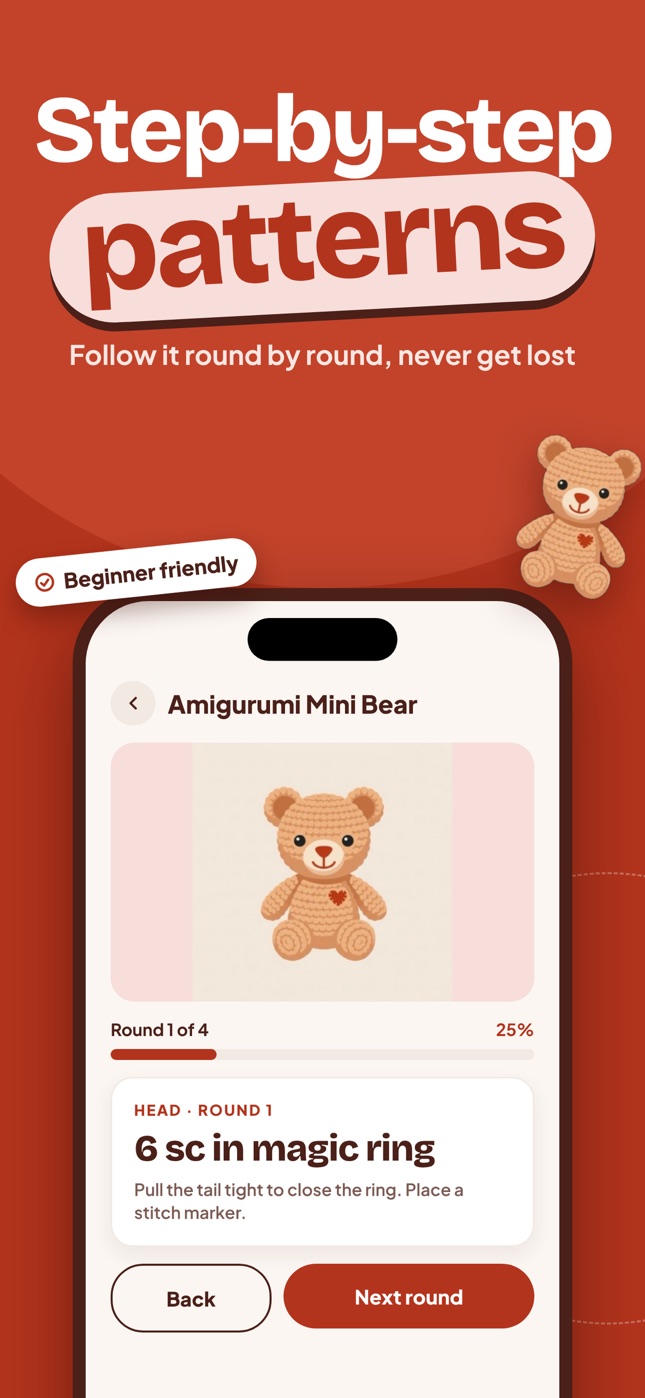
HookWise's beginner patterns introduce these stitches one at a time, inside projects you actually want, like a 15-minute coaster or a simple scarf. Each round is on its own screen, so you can focus on one stitch at a time, and the AI helper can explain any stitch the moment it appears.
Frequently asked questions
What is the easiest crochet stitch?
The chain and the slip stitch are the easiest, but the most useful first stitch is single crochet. It's simple and used in a huge number of patterns.
What order should I learn crochet stitches in?
Chain, single crochet, half double crochet, double crochet, slip stitch, then treble. Each adds one step to the previous one.
How many crochet stitches are there?
There are hundreds of named stitch patterns, but nearly all are combinations of the six basic stitches. Master those six and you can follow almost any pattern.
Which crochet stitch uses the least yarn?
Taller stitches cover ground faster for the yarn used, so a dc fabric typically uses less yarn per square centimeter than a dense sc fabric.
Crochet with a coach in your pocket
Learn to crochet with HookWise
94 step-by-step patterns that save your place, AI stitch & yarn identification from one photo, and an AI helper for when you get stuck. Free to download on iPhone.
Free on iPhoneDownload on the App Store